
So you didn't have time to read all the awesome science stories out of UC Davis this week? Here's a roundup for your weekend enjoyment.
Beetles and frogs find love
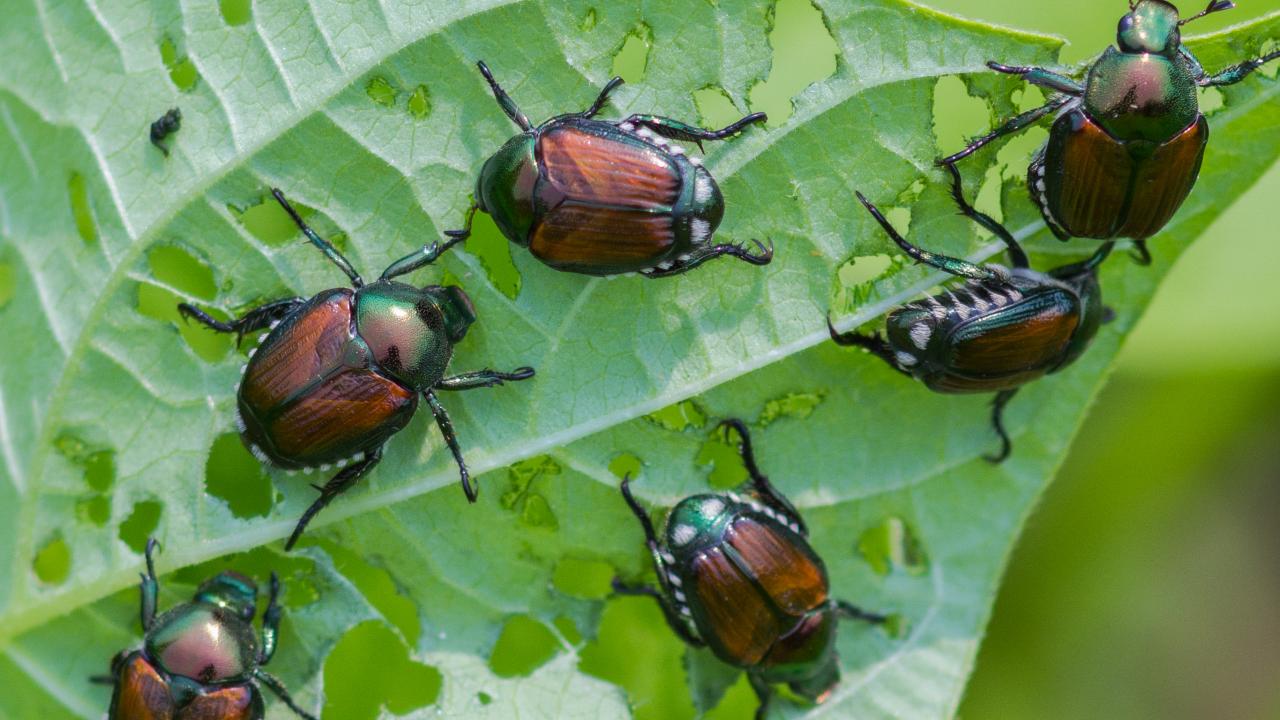
Professor Walter Leal and colleagues in China showed how scarab beetles can distinguish between mirror images of the same pheromone molecule. This prevents species that live alongside each other from interbreeding, which as Leal points out, is a waste of time and resources (at least from a utilitarian point of view). These beetles are major agricultural pests, so figuring out new ways to find them and stop them breeding is a big deal.
And just last week, graduate student Julianne Pekny showed how frogs' mating calls change as ponds get warmer: the frogs quite literally have to warm up before their songs start attracting mates. Climate change, of course, is making that all happen faster and earlier.
Bacteria at the leafy gates
Salmonella bacteria want to get inside salad leaves, but plants slam their stomata shut in their tiny faces. Professor Maeli Melotto's team at Plant Sciences has discovered that the bacteria can trick plants into opening the gates by producing auxin, a plant hormone. Sneaky!
"All right, leafy greens to 165, got it," commented a Reddit user.
Incredibubbles!
Extracellular vesicles are tiny bubbles that do all kinds of useful things by carrying proteins and nucleic acids between cells. They could, potentially, be used to target drugs to particular organs: for example, they can cross the blood-brain barrier. Aijun Wang, a professor in biomedical engineering and surgery, and Cheemeng Tan, professor in biomedical engineering have teamed up to develop a tool called VESSEL that allows them to study the proteins on the outside of these vesicles that help them carry out their missions.
CRISPR, but for plants
If you've been anywhere near biology in the past few years you will have heard about CRISPR/Cas9, the technique that lets scientists edit DNA inside cells with great precision and which earned a Nobel Prize in Chemistry for Jennifer Doudna and Emmanuelle Charpentier. But wouldn't you know it, CRISPR/Cas9 does not work well with plants. It requires a time-consuming two-step process and even that only works for some plants.
The good news is that Professor Savithramma Dinesh-Kumar at UC Davis and colleagues at the Innovative Genomics Institute in Berkeley have come up with an alternative, "pint-sized" gene editor that is much more efficient and effective in plants. That could make it much easier to create new disease- or drought-resistant, or better-yielding, crops.
We'll be waiting for the call from Stockholm.
The surprising insides of cells
Remember high school biology and the cutaway diagram of the cell with all the stuff like the nucleus, mitochondria and Golgi body neatly arranged? Yeah real cells are not like that: more like a crowded nightclub than a neat factory floor. But it turns out that things get even more crowded and chaotic when researchers moved from looking at single cells to cells within an organism, in this case the worm Caenorhabditis elegans. That work has been pioneered by G. W. Gant Luxton and Daniel Starr at the UC Davis College of Biological Sciences, and it is all described in this excellent article in Quanta.
You can also find a story about the work of the Starr-Luxton lab here.