

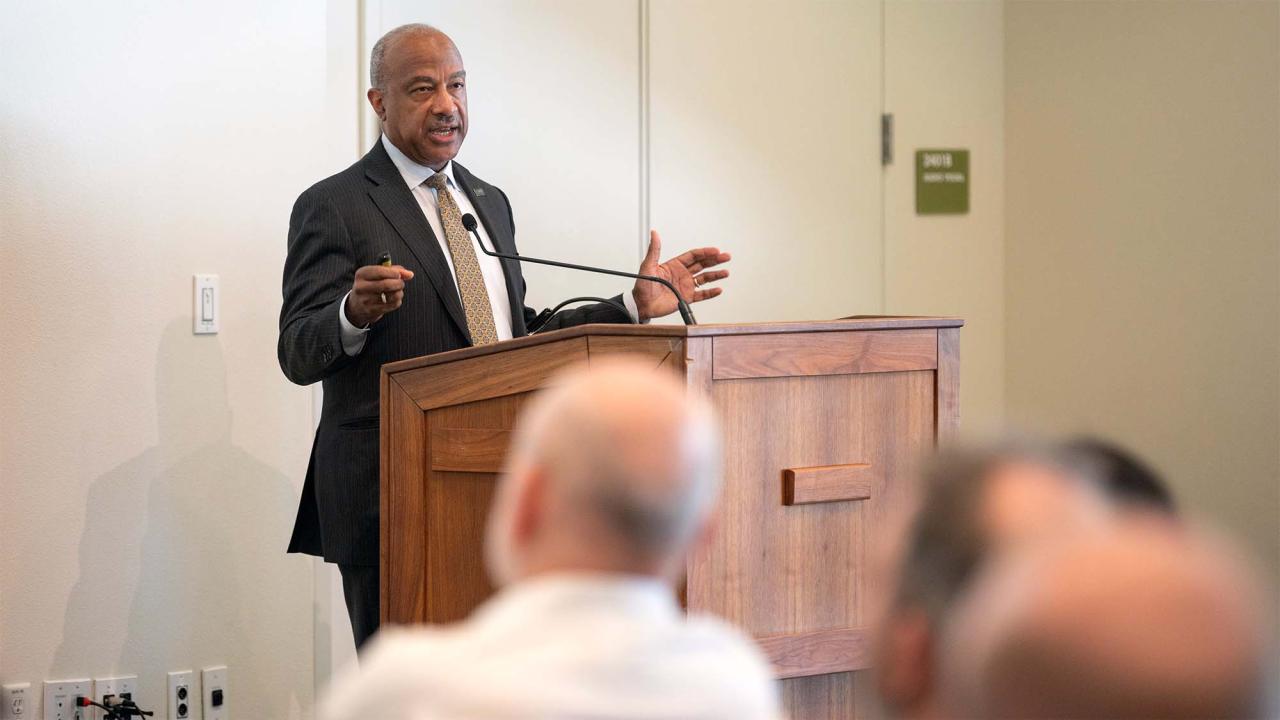
UC Davis has continued to improve lives amid the challenges facing universities across the country, Chancellor Gary S. May said at his annual State of the Campus address last week.
“We are not immune to these national forces, but we are prepared, engaged and resilient,” May said.
FULL REMARKS
His address, given at the Academic Senate’s Representative Assembly meeting on Thursday (Feb. 26), recapped the past year, from university rankings and faculty achievement to the impacts of a range of changing federal policies.
He restated the university’s goals:
“We are the engineers and creators building a more resilient future,” he said. “We empower students of every background to lead, we drive discoveries that save and improve lives, and we honor our land-grant mission by building a world that is as sustainable as it is just.”
Rankings, accolades
Some of the recent rankings May highlighted included UC Davis being named:
- The No. 2 public university in the nation (Wall Street Journal)
- The greenest university in the nation (GreenMetric)
- Among the top 25 public universities, the one whose students graduate with the least debt (Forbes)
“These rankings don’t just measure reputation,” he said. “They measure outcomes.”
He also highlighted faculty members, including:
- Professor Maceo Montoya, winner of an American Book Award for Imaginative Possibilities: Conversations with Twenty-First-Century Latinx Writers
- Distinguished Professor Carlito Lebrilla, a newly elected National Academy of Inventors Fellow
- Lynn Kimsey, distinguished professor emerita of entomology; and David Gold, associate professor of earth and planetary sciences, newly elected fellows in the California Academy of Sciences
- Subhash Risbud, professor emeritus of materials science and engineering, who was named a distinguished life member of the American Ceramic Society
Funding challenges
When May turned to the budget, he joked that a slide showing the detailed breakdown of university funding sources was always a favorite among faculty members.
Overall, funding from the federal government has been fairly consistent because of legal action and advocacy, he said: UC Davis saw a 1% increase in funding from the National Institutes of Health, or NIH, and a 3% decrease from the National Science Foundation, or NSF.
“That's a lot better than what we thought could have been,” he said.
Still, overall research funding for the 2025-26 fiscal year is expected to come in slightly lower and UC Davis is facing a $22 million drop in tuition revenue due to a decrease in international students. On state funding, May said the University of California system’s compact with the state was only 57% funded in its first four years, but Gov. Gavin Newsom’s latest budget proposal calls for the full funding amount this year, plus some additional money to partially catch up on previous years.
Changes in federal policy are having real impacts, but won’t deter UC Davis from its mission, May said.
He highlighted the fact that while UC Davis again hit the threshold for being designated a Hispanic-Serving Institution, or HSI, the Department of Education announced in the fall that it would no longer fund Minority-Serving Institution designations, including HSIs.
“But our commitment to students does not rise or fall with federal appropriations,” May said. “It is a fundamental part of who we are.”
Philanthropy
May also highlighted the impact of recent philanthropic gifts as being vital to UC Davis’ mission, “now more than ever.” Those include the gift of a property in Wasco, plus $5 million in startup funds, from Wonderful Nurseries, led by Stewart and Lynda Resnick. He also spotlighted the “transformative” $120 million gift from Joan and Sanford Weill to the Weill School of Veterinary Medicine, pointing out that it was the largest ever gift in all of veterinary medicine, at any university.
A call for help
May urged the faculty members in attendance to participate in the university’s From Labs to Lives campaign, which is working to show the impact of federally funded research. So far, more than 50 videos have been produced, and organizers are currently seeking “champions” — people who have benefitted from and are willing to advocate for the importance of federally funded research. Nominations can be submitted here.
“You have helped us show policymakers and the public how our research touches the lives of every person in our country and across the world,” May said. “We must remind them that when colleges meet their mission, they empower students to reach for the impossible and achieve it.”
Media Resources
Cody Kitaura is the editor of Dateline UC Davis and can be reached by email or at 530-752-1932.