

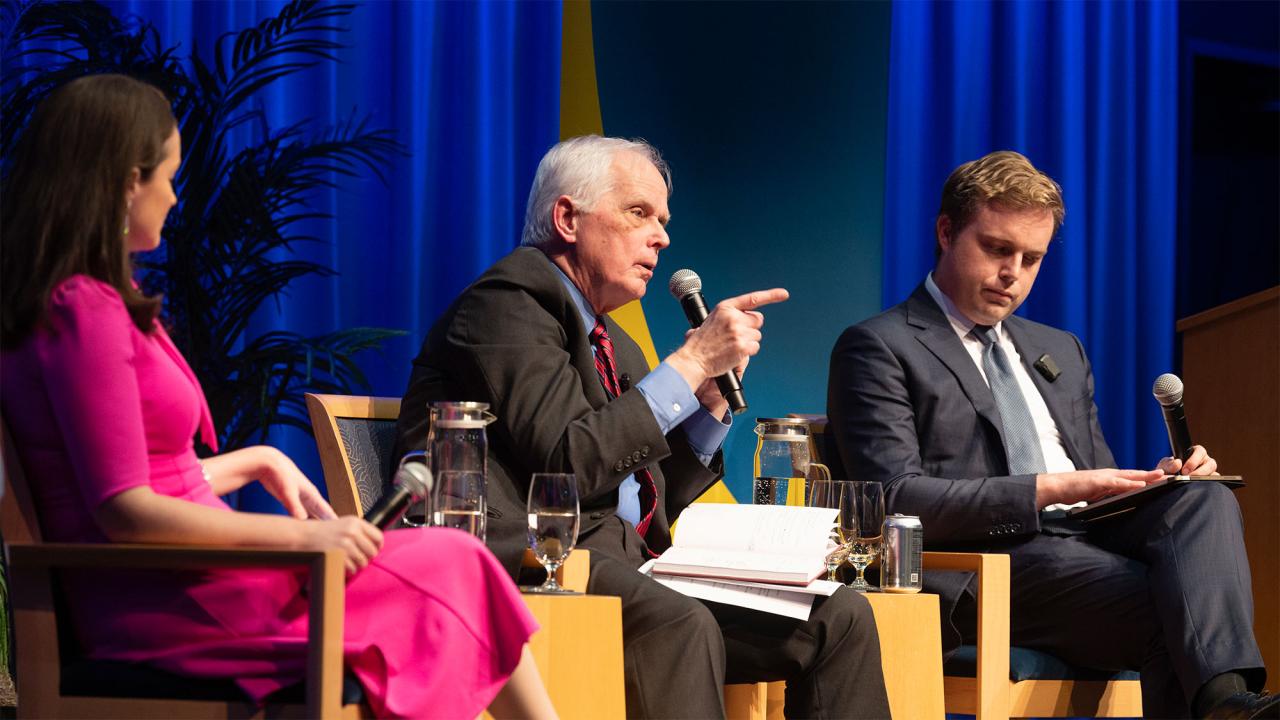
After watching two visiting economists debate at UC Davis last week over whether the federal government should be funding scientific research, many changed their views — but not everyone was convinced.
At an event organized by the Steamboat Institute as part of the Chancellor’s Colloquium Distinguished Speaker Series, Hoover Institution Fellow Jon Hartley and Cato Institute Adjunct Scholar John Early reached different conclusions about the ideal way to conduct research.
Debate focused on outcomes
Hartley argued in favor of increasing public funding for scientific research, saying it has been more than cut in half since the height of the Cold War. He said many advancements like the internet, GPS and semiconductors either received direct public funding or couldn’t have happened without it.
“These investments didn't just produce scientific papers — they produced really enormous economic returns, not just for these companies that were involved, but for society at large,” Hartley told the crowd in the Vanderhoef Studio Theatre on Feb. 18.
Hartley also said commercial successes like SpaceX came from areas where the entire field only exists because of government investment; he argued that no private company would be willing to provide the massive up-front investment with no guarantee of a return needed to start a field like spaceflight.
“No private investor in the 1960s could have created their own space program, but that initial showing of what was possible allowed the private sector to come along later to really take things to scale,” he said.
Hartley also argued that research provides a strong “social return” that benefits everyone. He said the nation should increase research spending to keep up with growing investment in places like China.
“If the U.S. reduces or fails to increase its investment, I think it really risks falling behind in technological leadership, which it's had for well over a century now,” Hartley said.
Early argued against public funding of scientific research, contending that most research institutions are too broad-based to provide useful outcomes.
“[The National Institutes of Health] and government agencies generally use the wrong model for research,” Early said, arguing that they seek to fund specific researchers instead of focusing on measurable goals like defeating a certain disease.
“[The government] has to sell the notion that it is hiring people, building offices and building computer systems, and if you read their budgets, that's what they're talking about,” Early said. “They almost never talk about the health improvements.”
He argued most of history’s major innovations came from private enterprise, and said the government’s large-scale investment crowds others out of a given sector.
“The federal government basically serves as a gate to stop research that they don't like and promote research that's probably useless,” Early said.
Some viewers swayed, some push back
Those watching in person and on a YouTube livestream were asked to vote on the question of the evening twice — before and after the debate. At the start of the event, 77% of voters agreed with Hartley’s position, while 20% were undecided and a small sliver sided with Early.
After the event, Hartley’s side of the debate fell to 54% and Early’s rose to 29%. Seventeen percent remained uncertain.
Steve Camden, a project manager with Design and Construction Management, said it was easy to see who came out ahead: “Mr. Early won the debate, clearly.”
Camden said Hartley didn’t make a persuasive argument.
Others watching in person took issue with some of the points made by the panelists.
Walter S. Leal, a distinguished professor of molecular and cellular biology, attended with dozens of his students. He called Early “eloquent,” but said he used misleading examples.
At one point, Early argued that Pfizer’s COVID-19 vaccine was developed without any federal funding. Leal said while that company didn’t take federal funding to create the vaccine, it would have been impossible without the Nobel Prize-winning research of Katalin Karikó and Drew Weissman, whose work was supported by numerous federal grants over the years they spent developing their mRNA technology.
Similarly, Ken Burtis, professor emeritus of molecular and cellular biology, took issue with Early saying the cure for polio was developed solely by the donor-funded March of Dimes. That vaccine, Burtis said, was just one development in a long series of discoveries made with the help of federally funded research.
“[Only] the last step was privately funded,” Burtis said.
A respectful disagreement
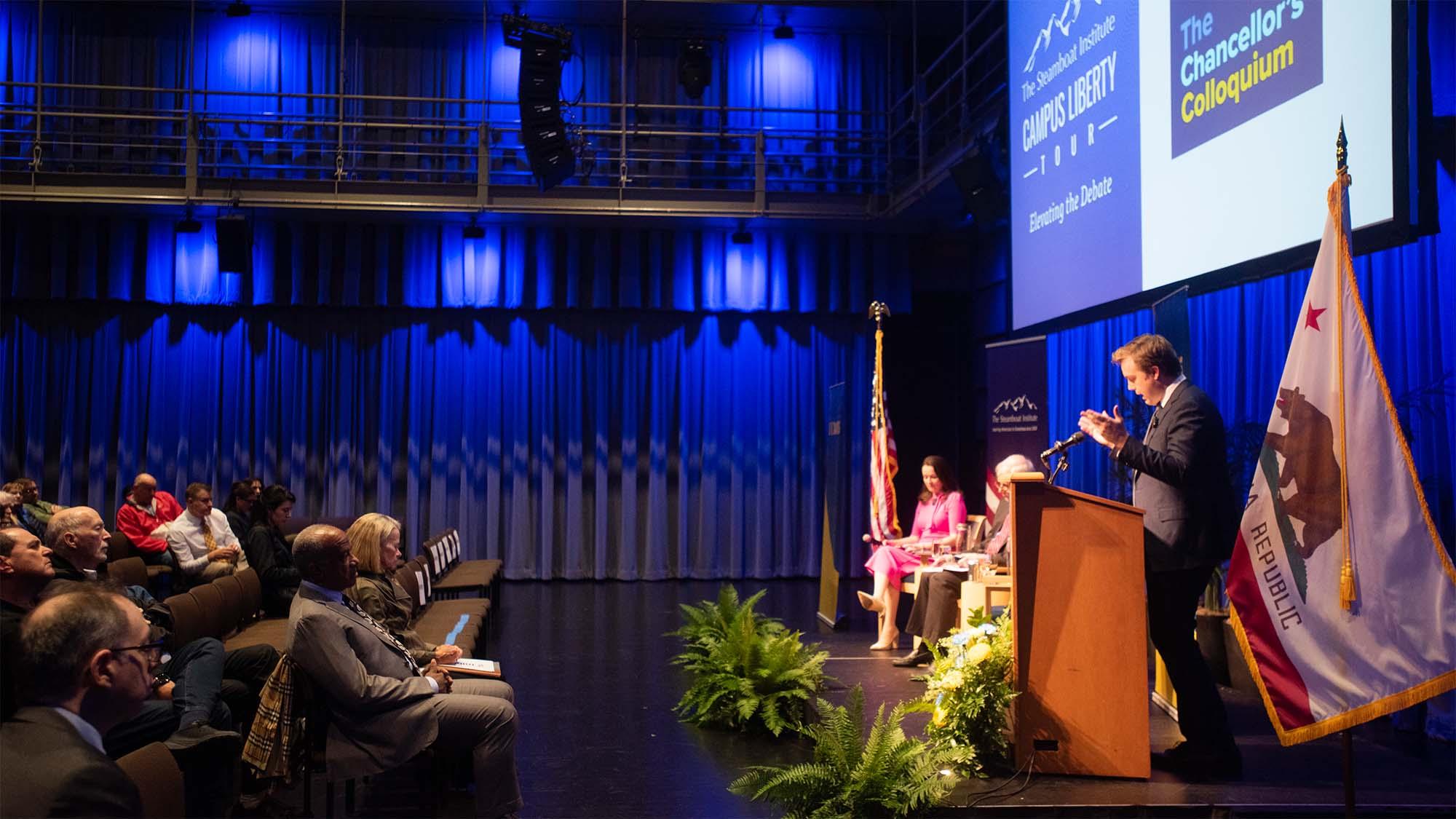
Many at the event said they were glad to see the discussion taking place on campus.
Arthur Issler, a third-year biotechnology major, said it was “definitely worth it to experience” the event in person.
In his opening remarks, Chancellor Gary S. May said that while he was firmly in favor of federally funded research, he was glad to welcome other points of view at the event.
“This approach represents our respect for freedom of speech as a core value that’s vital to our mission at UC Davis,” May said. “Our Principles of Community emphasize open dialogue to foster mutual respect and understanding. More than ever, we need to allow for an exchange of ideas that is at the heart of democracy’s roots. We need people who can engage in civil discourse, disagree respectfully and build bridges instead of walls.”
Media Resources
Cody Kitaura is the editor of Dateline UC Davis and can be reached by email or at 530-752-1932.