

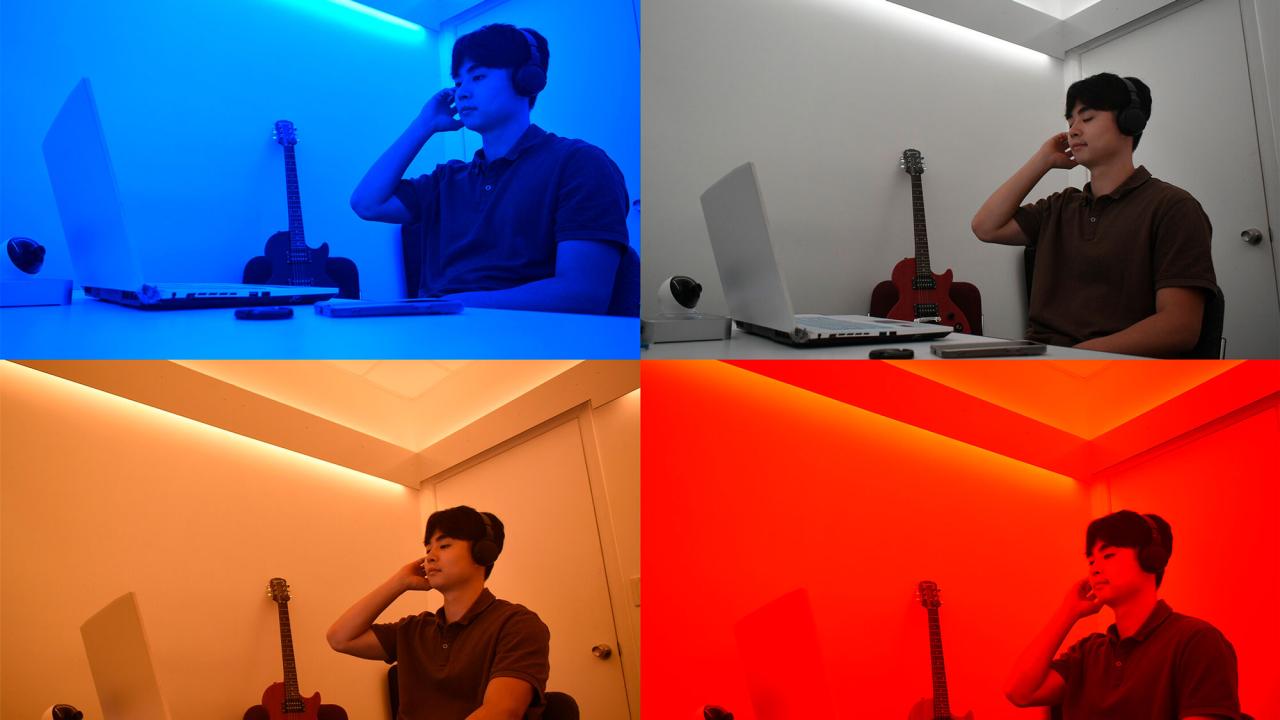
When you go to your next concert or listen to your favorite music on an app, you might first consider the lighting around you.
Music is widely known for its ability to arouse, change moods or trigger a cathartic emotional release in people. A multidisciplinary team from three universities found that indoor lighting of various hues so strongly influences listeners’ experiences that musical venues, health-care settings and even homeowners might wish to reconsider their lighting choices for maximal effect and enjoyment of their music.
“Some performance halls and auditoriums are already using color-changing LED systems during their programs, but most don’t really know which colors are most effective for shaping different emotional responses as there is no scientific evidence,” said Jae Yong Suk, associate professor in the Department of Design, director of the California Lighting Technology Center at the University of California, Davis, and a co-author of a new study.
“Our study helps give them a clearer direction, so lighting choices can be more intentional and emotionally supportive rather than just aesthetic.” He has led recent research that looked at lighting effects on stress and anxiety.
The new study’s lead author, Dongwoo (Jason) Yeom, of Clemson University, said the research also has implications for improving well-being, mood regulation and even recovery for patients in long-term care settings.
The study, “How Can Lighting Enhance Your Perceptual Music Listening Experience?” was published in November in the journal Lighting Design & Application. Few studies have directly examined how indoor environments influence perceived emotions in music, authors said. This study examined the effects of lighting conditions on music perception, such as positivity ratings, lighting-music fit, and lighting satisfaction.
Yeom led the study initially at Arizona State University, and continued in his current role at Clemson University, where he is a Penney endowed distinguished associate professor in the Richard A. McMahan School of Architecture.
Listening to music under different lighting conditions
Participants were exposed to a range of lighting conditions while listening to two types of music, categorized as happy and sad, and asked to rate both the emotional experience and how well each piece matched the corresponding lighting setting. The musical excerpts consisted of popular music pieces that had been previously used in music and emotion research and had been reliably rated as either happy or sad.
In an Arizona State University location outfitted with 12 LED smart lights and a lighting control system, 22 participants were randomly assigned to lighting conditions that included blue, cool white, red and warm white lighting. Happy music received the most positive responses when using warm white lights, and the least positive response came from blue lighting. On the other hand, when participants listened to sad music, they gave the lowest ratings to red lighting and the highest rating to blue lighting, which surprised researchers because previous research pointed to blue wavelengths as stimulating or energizing and something that helps people stay alert.
Cool-white lighting, despite generally being visually acceptable, was rated as the least fitting for happy music.
The new research indicates that neutral or cooler-toned lighting might feel emotionally disconnected from upbeat music. Thus, designers should consider not just visual comfort but also the emotional compatibility between lighting and music type.
All the findings suggest that matching lighting to music could help create a more calming, energizing or emotionally supportive experience — whatever the moment calls for, the authors said.
Co-authors of the study include Kristina Knowles, affiliate faculty in the School of Music at ASU, and Seonghyuk Son, a Ph.D. candidate at Clemson.
Media Resources
Media contact:
- Karen Nikos-Rose, UC Davis News and Media Relations, 530-219-5472, kmnikos@ucdavis.edu