


They are experts in a parasitic amoeba, scientific history, the health effects of stress and more, and now these eight faculty members can add a new title: Chancellor’s Fellow.
The recognition is given each year to early career academics doing exemplary work, and the 2025-26 class will be recognized at a reception next week.
“I am continually inspired by the brilliant work of faculty across every area of the university,” said Chancellor Gary S. May. “I’m honored to welcome the 26th class of Chancellor’s Fellows to a group of those who have a long history of making an impact on our students, our region and our world.”
The Chancellor’s Fellows program was created in 2000. Recipients carry the title for five years and are awarded $25,000 in unrestricted philanthropic support for research or other scholarly work.
“This program is a perfect example of the impact of philanthropy,” said Shaun B. Keister, vice chancellor for Development and Alumni Relations. “These researchers go forth to make a difference in many areas of the world, and we are honored to have a hand in supporting the early stages of their work.”
The nominees for the award are selected by their respective deans, and Philip Kass, vice provost of Academic Affairs, said the recognition was a sign that these faculty members are truly among the most remarkable of their peer group.
“These bright researchers are some of our most promising academics, and our faculty review committee and I are confident they will accomplish even more impressive work now that they’ve achieved this honor,” Kass said.
The 2025-26 Chancellor’s Fellows are:
Reina Engle-Stone
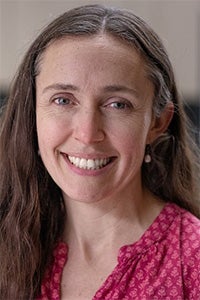
Engle-Stone studies vitamins and minerals that are essential for the health of women and young children in low- and middle-income countries. Her research has helped shape nutrition programs and food fortification policies around the world. She was part of a team that created tools to measure how well fortified bouillon cubes could help reduce malnutrition in West Africa. She has led or collaborated on projects in more than a dozen countries, producing research that directly informs international nutrition policy.
“The breadth, quality, and translational impact of her research position her as a rising leader in global nutrition and public health,” said Ashley M. Stokes, dean of the College of Agricultural and Environmental Sciences. “Her work has saved lives, informed policy, and trained the next generation of nutrition scientists.”
Camelia Hostinar
Associate Professor, Department of Psychology, College of Letters and Science
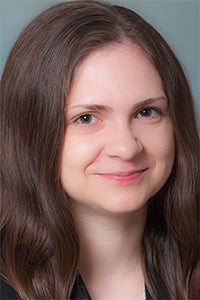
Hostinar, a developmental psychologist, studies how stress affects health across people’s lives with a focus on the body’s response to stress, particularly in early life. Her research also examines ways that might reduce the long-term harm caused by early life stress.
“She is at the forefront of creating a new understanding of the causes, manifestations and effects of stress in childhood and adolescence, and what can be done to mitigate and resolve the impacts of stress,” said Paul Hastings, a professor of psychology. “She has woven a network of collaborative scholarship that unites the strengths of our university.”
Emily Merchant
Associate Professor, Department of Science and Technology Studies, College of Letters and Science
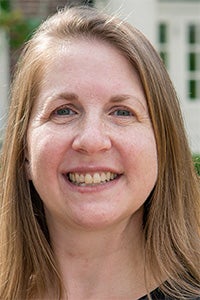
A science historian focusing on the 20th and 21st centuries, Merchant analyzes quantitative human sciences and technologies of human measurement. Merchant's current project is a book titled Molecular Eugenics: The American Pursuit of Intelligence Genes. It will explore the 100-year history of eugenics in the social sciences and its impact on modern sociogenomics, a field that’s explored the genetic basis for educational attainment and income.
“Emily Merchant is an exciting, accomplished scholar who is reinventing the history of the social sciences in the 20th century," wrote Dan Bouk, professor and chair of the Department of History at Colgate University. “She is a gifted, and tireless, archival researcher — a historian’s historian.”
Marina Radulaski
Associate Professor, Department of Electrical and Computer Engineering, College of Engineering
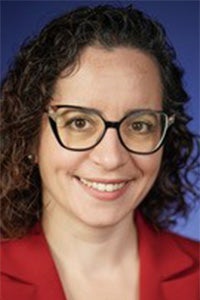
Radulaski leads the UC Davis Laboratory for Quantum Nanophotonics. Bridging engineering, physics and material sciences, her research involves the interaction of light and materials at extremely small scales. Radulaski’s work has applications in quantum hardware for networking and simulation, as well as in the near-term use of quantum computers.
Radulaski’s research has attracted numerous awards and grants. She founded the UC Davis Quantum Information Science and Technology, or QuIST, initiative, which crosses departments and colleges, and also mentors student clubs in optics, quantum science and for female engineers.
“Professor Marina Radulaski exemplifies the very best of UC Davis,” wrote Professor Saif Islam, chair of the Department of Electrical and Computer Engineering, in nominating her for the award.
Katherine Ralston
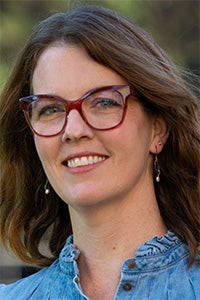
Ralston studies a parasitic amoeba called Entamoeba histolytica. Spread by contaminated food and water, Entamoeba causes severe gut disease including diarrhea, ulcers and bleeding. Sometimes it breaks out of the gut and attacks other organs, such as the liver.
Ralston discovered an entirely new way in which the parasite attacks host cells by “nibbling” small pieces from them, rather than engulfing them whole. She has since made discoveries on how Entamoeba protects itself against the host immune system by putting proteins from cells it has devoured on its own surface.
“[Ralston] is a rising star in her field of molecular parasitology and an exceptional academic scholar, mentor and teacher, who actively advances her profession and research area,” wrote Wolf-Dietrich Heyer, Distinguished Professor and chair of Microbiology and Molecular Genetics.
Mohammad Sadoghi
Associate Professor, Department of Computer Science, College of Engineering
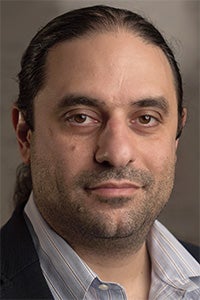
Sadoghi’s work focuses on large-scale databases, distributed ledgers, and blockchains. These systems distribute data across many computer systems, which must agree on what the data are, even if the systems do not necessarily “trust” each other. His work has implications not only for data verification but also for how computer systems and the technology industry understand and implement laws governing data security and privacy.
Sadoghi founded Apache ResilientDB, a distributed ledger built on a democratic, decentralized computer model. His recent book, The Problems of Consensus: An Ethical Inquiry into Democratic and Decentralized Principles, explores the concept of consensus, weaving together ethical, epistemological, theological, sociological and computational perspectives into a unified dialogue.
“[Sadoghi’s] work is at once principled and practical: He rethinks consensus from first principles, proves what is possible under realistic assumptions and then transforms those ideas into robust open-source systems,” wrote Amr El Abbadi, Distinguished Professor of computer science at UC Santa Barbara, in support of Sadoghi’s nomination.
Laura Starkston
Associate Professor, Department of Mathematics, College of Letters and Science
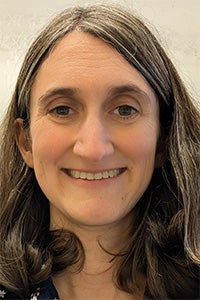
Starkston’s research is in symplectic topology, low-dimensional topology and algebraic geometry. A key approach in her research in these areas is to represent objects in four dimensions using diagrams in two or three dimensions. Starkston has made major contributions in this area, which has connections to a wide range of fields, including high energy physics.
Starkston’s work has been supported by a series of grants, including an NSF CAREER award and Sloan Research Foundation fellowship. She is a sought-after speaker at international conferences and highly praised as a teacher at both the undergraduate and graduate levels.
“I cannot think of a better candidate than Laura for a Chancellor’s Fellowship. Certainly, I have not seen one in my 29 years at UC Davis,” wrote Bruno Nachtergaele, Distinguished Professor and chair of the Department of Mathematics.
Katia Vega
Associate Professor, Department of Design, College of Letters and Science
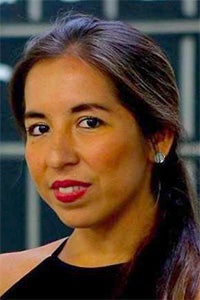
An internationally recognized leader in the field of bio-human-computer interactions, Vega’s research leads new explorations of organisms-device symbiosis. She has pioneered new domains that embed biosensors and electronics seamlessly into cosmetics, wearables and living materials, and is the founder and director of the Interactive Organisms Lab. Her innovations have reshaped how we understand the relationship between organisms and devices, pushing the boundaries of design, biotechnology and computing.
Her colleagues describe her as a team player and a creative “star” who continually works to uplift others, especially underrepresented women in technology. She is known for her consistent, long-held commitment to her students, peers and community.
“Dr. Vega is an extremely rare and unique researcher — demonstrating consistent excellence in research taste, human empathy, technical execution and design polish,” wrote Professor Eric Paulos, faculty director for the Jacobs Institute for Design Innovation at UC Berkeley.
Media Resources
Cody Kitaura is the editor of Dateline UC Davis and can be reached by email or at 530-752-1932.