

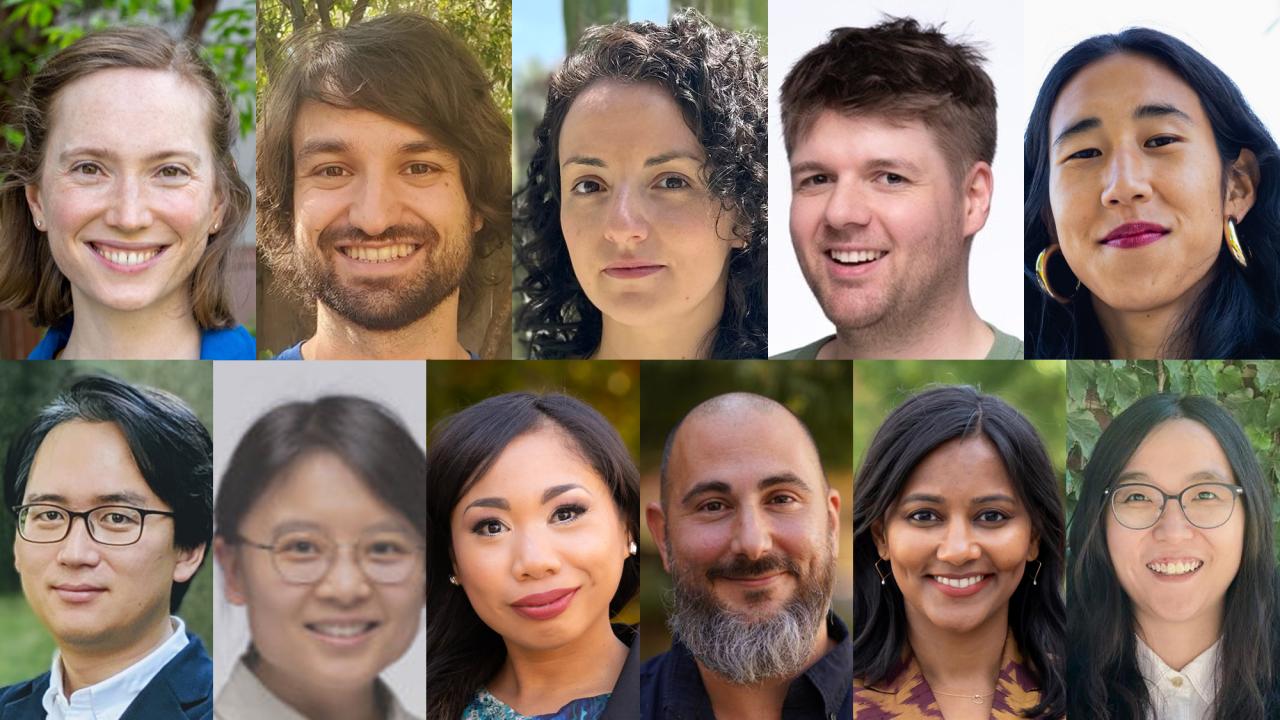
Eleven faculty members are receiving support for their work through this year’s Hellman Fellowships, and it comes right when they need it most: early in their careers.
“It can be immensely helpful to provide direct research funding to faculty members after their second or third year, when their work is ramping up but initial funding is running out,” said Phil Kass, vice provost of Academic Affairs. “This support helps provide a boost for their work and is vital in securing external funding.”
Grants this year range from $15,000 to $40,000, for a total of $320,000 awarded.
RELATED READING
The Hellman Fellowships were established in 1995 through gifts from Chris and Warren Hellman to UC San Diego and UC Berkeley. It was eventually expanded to every UC campus, including UC Davis in 2008, and was made permanent through endowments to each campus in 2020. UC Davis’ endowment for the program was $6 million, ensuring the awards can continue in perpetuity through our own Society of Hellman Fellows.
The Hellmans also intended their endowments to encourage others to contribute to the societies. For more information on donating to the UC Davis society, contact Jennifer Prahl, senior director of foundation engagement, Office of Development and Alumni Relations, by email or at 530-752-1282.
More information on the fellowship is available on the Academic Affairs website.
Kass called the endowment a “wonderful gift” to support early-career faculty members as they develop at UC Davis, and said the university was honored to be a steward of the program.
“These faculty members have already made great strides in their respective fields, and we are excited to help them continue to make further progress here,” Kass said.
Read more about the history of the program on the Hellman Fellows website.
This year’s recipients come from fields as varied as psychology, mathematics, plant biology, design and more. Read more about them and see the titles of their funded projects below.
The 2025-26 fellows
- Laura Bogar, Department of Plant Biology, College of Biological Sciences: “Untangling Symbiotic Networks With CRISPR for a Root-Associated Fungus”
- Matthew Citron, Department of Physics and Astronomy, College of Letters and Science: “A FLAME to Light the Dark Universe”
- Daniela Gutierrez-Flores, Department of Spanish and Portuguese, College of Letters and Science: “A Century of Cooks: The Birth of Modern Cooking and the Making of the Spanish Empire”
- Hanno Hilbig, Department of Political Science, College of Letters and Science: “The Political Consequences of AI-Driven Labor Market Change: A Comparative Study”
- Ava L.J. Kim, Department of Gender, Sexuality and Women’s Studies, College of Letters and Science: “Still/Life: Trans Genre and the Politics of Anti-Development”
- Soojong Kim, Department of Communication, College of Letters and Science: “Global Flow of Misinformation on Public Health and Environmental Threats”
- Junxian Li, Department of Mathematics, College of Letters and Science: “Diophatine Equations in Few Variables”
- Ariel Mosley, Department of Psychology, College of Letters and Science: “Diversity Ideologies on Perceptions of Cultural Appropriation in Interracial Interactions”
- André Naffis-Sahely, Department of English and Department French and Italian, College of Letters and Science: “The Refugees of Happiness: How ‘Gross National Happiness’ Feeds Global Statelessness”
- Akshita Sivakumar, Department of Design, College of Letters and Science: “Design for Accountability: Responsible AI in Environmental Governance”
- Runzi Wang, Department of Human Ecology, College of Agricultural and Environmental Sciences: “Investigating How Residential Planting Design and Fertilizer Application Affect Urban Stormwater Nitrogen Pollution from a Socio Ecological Framework”
Media Resources
Cody Kitaura is the editor of Dateline UC Davis and can be reached by email or at 530-752-1932.