

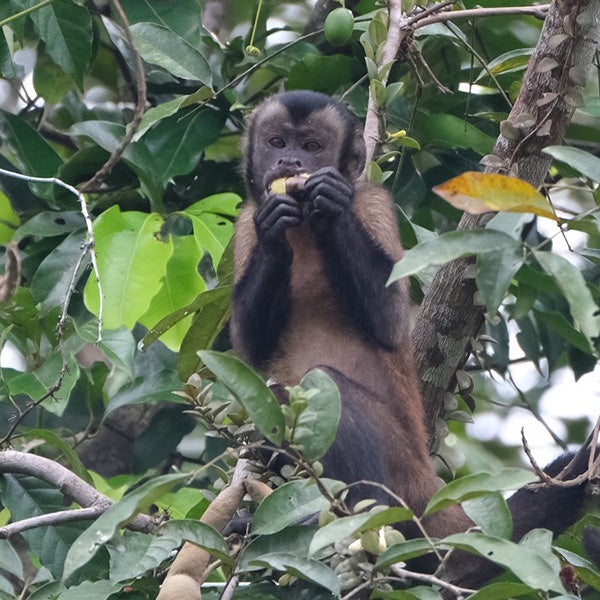
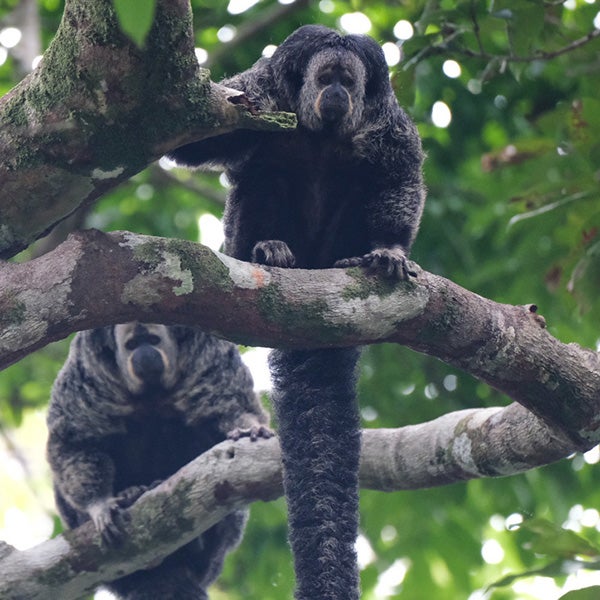
Abigail Morris first visited the Peruvian Amazon when she was 6 years old. Now, as a Ph.D. candidate in the Animal Behavior Graduate Group, she has returned to study how seasonal flooding affects the behavior, diet and population genetics of two species of monkey: monk sakis (Pithecia monachus) and large-headed capuchins (Sapajus apella macrocephalus).
“My goal is to better understand how environmental factors influence the decisions individual monkeys make when they disperse from their family group,” said Morris. “Understanding how dispersal behavior impacts population genetics can help inform future conservation efforts.”
Should I stay or should I go?
Many social animals leave their family groups once they reach maturity. In some species, both male and female offspring disperse, while in other species, only individuals of one sex disperse.
“These behaviors play a key role in genetic and cultural evolution,” said Morris. “The decision one individual makes can start a loop, since that individual's offspring will likely make a similar decision, and so on. Throughout generations, this can result in groups that begin to diverge despite living really close to each other.”
Whereas monk sakis live in small family groups consisting of one pair of adults and their juvenile offspring, large-headed capuchins live in larger social groups.
“We don't know a lot about the dispersal behavior of either of the species I'm studying, but based on their social structures, it's thought that among capuchins, males disperse and females stay in the group that they’re born into, whereas both male and female monk sakis disperse,” said Morris. “By studying both species, I can compare how different dispersal patterns can be affected by both environmental factors and group structure.”
Because these behaviors are difficult to observe directly, Morris is using genetics to study their dispersal patterns.
“By looking at the monkeys’ genetic makeup, we can map how individuals in different habitats and territories are related to each other, she said. “You can also trace genetic lineage back through one or two generations, kind of like a pedigree.”
In case of flooding: a guide for monkeys
Morris returned to Peru in August to conduct a pilot study in the Área de Conservación Regional Comunal Tamshiyacu-Tahuayo, a community reserve to the southeast of Iquitos. There, she collaborates with researchers at the Amazon Research Center and local field guides, and she mentors interns through Amazonia Expeditions, the company that owns the Amazon Research Center.
The reserve is made up of a patchwork of habitat types including the swampy igapó forest, which floods annually from November through May when snowmelt from the Andes causes rivers to rise by up to 9 meters, and the terra firma, which remains unflooded year-round.
“When it floods, terrestrial mammals in the igapó usually migrate to the terra firma to get away,” said Morris. “But the monkeys seem to stay put a lot of the time, which means they might have to adjust their diets during the flood season.”
Monk sakis and capuchins live in both the igapó and terra firma. Morris wants to know how this seasonal flooding affects the monkeys’ diets and behavior, especially whether it determines how younger monkeys disperse from their families to join or form new groups.
All paths lead back to Peru
Morris originally planned to become a wildlife veterinarian but pivoted to a career in research when she realized that it would allow her to do in-the-field conservation work.
“When I was 6 years old, my parents met a couple who owned an ecotourism lodge in Peru, and my mom decided to take us there,” said Morris. “I saw monkeys in the wild and fell in love.” After completing her undergraduate degree, Morris returned to Peru to work as a staff biologist at the Amazon Research Center for six months. She joined UC Davis in 2022 and spent her first two years studying gorillas in the Congo before once again gravitating back to Peru and its primates.
“Very few students demonstrate as much autonomy as Abby,” said Damien Caillaud, Morris’ advisor and an associate professor in the Department of Anthropology. “I am already very proud of her achievements, and I look forward to learning with her how amazonian monkeys transfer between social groups in a mosaic of habitats.”
Tracking monkeys by canoe
“It's actually easier to find the monkeys during the flood season, because they don't hear you coming,” said Morris. “It floods so much you can't even walk, but by canoe, you can move through the forest very peacefully, and you can get closer to the monkeys because they can’t hear you and you're higher up.”
To locate the monkeys, Morris’s team canoe and hike through the forest, looking for signs of movement in the treetops. When they spot a group of monkeys, they note the number of individuals and try to observe what the monkeys are eating. Morris also takes photos to try to identify individual monkeys based on their facial features and collects fecal samples to extract DNA, which she will analyze to understand both the monkeys’ genetics and what plants they’ve been eating.
“Monkeys learn a lot from the environment they grow up in, like how to identify and process different foods, so we would expect them to try to seek out a similar environment when they leave their family group,” said Morris. “I’m testing whether this is true for monk sakis and capuchins. This has conservation implications in terms of reintroducing animals, because you’d ideally want to raise them in an environment similar to where you plan to release them.”
Morris’ research in Peru is supported by a National Science Foundation Graduate Research Fellowship and a Richard G. Coss Wildlife Research Award.