
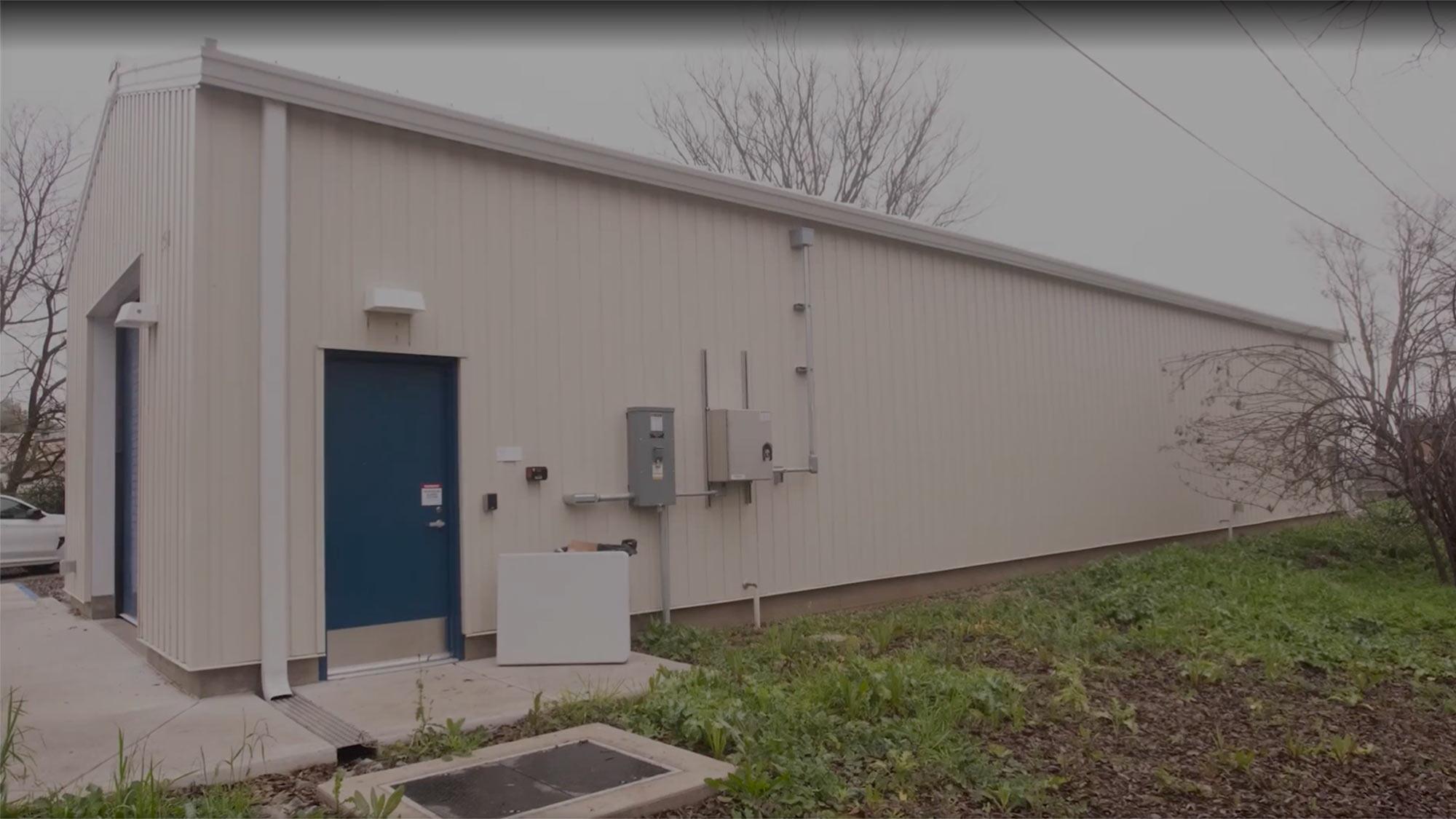
An unassuming metal barn erected recently at the southern edge of the University of California, Davis campus houses some advanced video technology for a uniquely UC Davis project.
Leveraging UC Davis’ historic strengths in veterinary medicine and engineering, the Center for Animal Flight and Innovation is the only facility of its kind in the United States and one of very few in the world capable of capturing images of birds in flight in exquisite detail. It will use state-of-the-art technology to get new insights into how birds — specifically, hawks and other raptors — maneuver in the air.

Some raptors are among the fastest birds in flight; many have a great ability to maneuver in tight spaces or around obstacles to track and seize prey. Understanding how the birds perform these feats could lead to improvements in uncrewed aerial vehicles, also known as UAVs or drones, as well as in understanding how to treat and rehabilitate injured birds.
The Center for Animal Flight and Innovation was hatched from a collaboration between Christina Harvey, assistant professor of mechanical and aerospace engineering, and Professor Michelle Hawkins at the Joan and Sanford I. Weill School of Veterinary Medicine and the California Raptor Center. A grant from U.S. Army Combat Capability Development Command Army Research Laboratory equipped the center with cutting-edge technology to capture detailed images of birds in flight to advance UAV research.
Raptor Center captures engineer's attention
Harvey alighted at UC Davis in 2022 after earning her doctorate at the University of Michigan, where she studied the dynamics of bird flight, including how birds can shift between stable and unstable flight. The opportunity to work with avian veterinarians and biologists — including the California Raptor Center — was part of what drew her to UC Davis.
Hawkins said she was bemused when she first got an email from Harvey. Why would a candidate for a faculty position in engineering want to visit the raptor center? Out on leave at the time, she arranged for Harvey to get a tour while interviewing at UC Davis.
After moving to UC Davis in 2022, Harvey reached out again.
“She talked about her Ph.D. work, and things started getting clearer, and I thought it sounded fabulous and a perfect collaborative match,” Hawkins said.

Building a lab at the California Raptor Center isn’t just about location. The perspectives of veterinarians and biologists are essential to Harvey’s vision.
“One of the hard things about our job is trying not to use too heavy of an engineering approach,” Harvey said. “We really need vets like Michelle [Hawkins] and biologists to step in and be, like, ‘No, no, there's a lot happening within the system for birds to be able to achieve some desirable function.’ We need to keep those people who understand the animals themselves in the loop, and that's what makes the work special.”
Rare raptor research facility
Founded in 1972, the California Raptor Center has been at its current location, a former campus wastewater treatment plant near Putah Creek on the south campus, since 1974. It takes in 100 to 200 sick, injured or orphaned raptors a year, about 60% of which are later returned to the wild. The center offers training in care and management of birds of prey as well as educational programs to schools and community organizations.
After winning the federal grant, the bird flight facility broke ground in fall 2024, and the first experimental flights began this winter.
Inside the barn, the walls are lined with white curtains, and bright white lighting mimics daylight to keep birds comfortable. Rows of infrared cameras at floor and ceiling height allow researchers to track the movements of birds’ wings, tails and bodies by putting small reflective dots on them, just like the motion-capture technology used by animation studios. The system can track a bird’s movements with submillimeter accuracy, Harvey said.

At the same time, eight high-speed video cameras can record 1,000 frames per second at 4K resolution to capture movements that can be analyzed from every angle, reconstructing a bird’s movements with unprecedented detail and precision.
“From each of these views, you can segment out the bird itself and then use a triangulation algorithm to create a full 3-D shape,” Harvey said. “So we're working to link the high accuracy of our marker-based tracking with this more 3-D based full reconstruction.
“We're the only lab in the U.S. that I'm aware of that could fly birds in this type of facility,” Harvey added.
The Bird Flight Research Center can also make use of other facilities in the College of Engineering. Based on what they observe in the video reconstructions, the engineers can pull out wing shapes, make 3-D print models of them and test them in the College of Engineering’s wind tunnel, which Harvey co-operates.
“The wind tunnel gives us the experimental ability to do the aerodynamic force calculations, whereas this lab lets us get the true biological information of what's happening,” Harvey said.
Improving rehabilitation for injured raptors
A self-described “bird nerd,” Hawkins said she sees great potential for the new capabilities in avian medicine.
“I’m interested in how to fix birds and be as successful as possible when releasing them back into the wild,” she said.
The daily work of the center is to rehabilitate sick and injured raptors. Many of its patients have wing injuries, often requiring surgery. Anyone who has suffered an injury knows that getting back to full use of a limb takes time.
“They all need rehabilitation if they are going to be successful at hunting and being the birds they are,” Hawkins said.
Unlike a human patient, an animal can’t tell you where it hurts or when it is ready to move again. So veterinarians have developed protocols to assess birds for their fitness for release into the wild.
“Every year we learn something new, but in the end it is all subjective,” Hawkins said. “I want to have the most objective criteria I can use to decide when to release a bird.”

Combining aerospace engineering with veterinary medicine
Hawkins said she hopes to use the lab to develop a database on flight behavior of healthy raptors, possibly including birds that are housed at the center for other reasons and used in educational programs. Rehabilitated birds could be recorded in the flight hall and compared to healthy birds to see if they are ready to be returned to the wild.
Beyond veterinary treatment, there is still a lot we don’t know about how birds fly, Hawkins said.
“There are 10,000 species of birds, and they’re all different,” she said. “Even though we think we know a lot, when we get down to it, there are ambiguities. There is still a lot of work to be done.”
Apart from the technology in the new lab, it is the opportunity for engineers to work directly with veterinarians that makes the new collaborative center special, Harvey said.
“Not only is it special because of any type of capability, but we have the best vet school in the world, and they are very engaged with this. So I do think that there's a unique potential that isn't elsewhere,” she said. “I’m so incredibly excited that the facility is finished and the work has begun.”