


Paul Eastwick was in high school when he first came across the idea that evolution might explain how and why humans love. It was in a 1994 Time Magazine article about the book The Moral Animal by Robert Wright.
At first glance, the idea fascinated him. It appeared that the bedrock scientific principle of evolution could explain the nuts and bolts of what makes us human, from our sense of morals to our spectrum of emotions that include love.
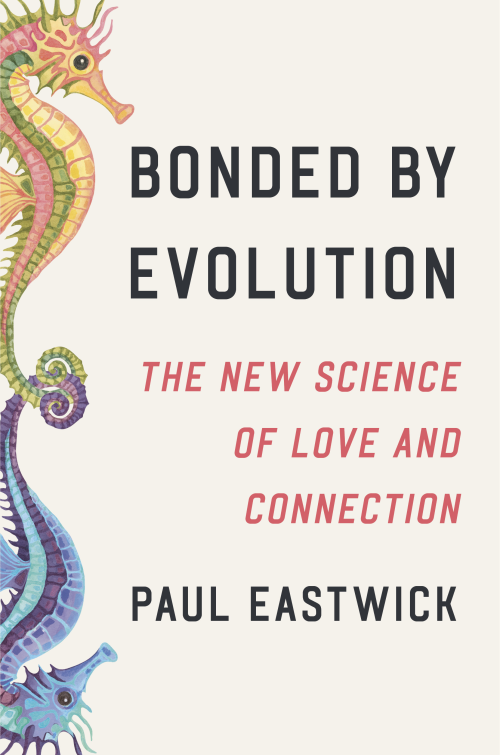
Cover image for "Bonded by Evolution" by Paul Eastwick.
Then he read the article more closely and found a story about men and women in perpetual conflict. He was shocked to learn that all the terrible things men and women do to each other, from cheating to always seeking to ‘trade up,’ was explained by evolution.
“I thought, if this is true, then this is terrible,” said Eastwick, a professor of psychology in the College of Letters and Science at UC Davis.

Across his career, Eastwick has been building on ideas about evolution and love that are very different from the ones he first learned about in high school. His new book, Bonded by Evolution: The New Science of Love and Connection(Penguin, 2026) explains what happens when the mist of desirability wears off and compatibility has the chance to chart lasting love and happiness.
How evolution explains love
Evolution is the well-established scientific theory that explains how populations of living organisms, from bacteria to humans, change over time through genetic changes that are passed down to future generations.
Eastwick grounds his research exploring human evolution and love in the Social Relations Model, which was developed by David Kenny and Lawrence La Voie in the 1980s. According to this model, romantic feelings are made up of three distinct parts:
- Selectivity: How attracted to people in general a person tends to be
- Desirability: A consensus about how desirable a person is to others
- Compatibility: How one person feels uniquely about another person above and beyond selectivity and desirability
“If you're not careful about which one of these you're studying, your conclusions can go all over the place,” said Eastwick.
In his lab at UC Davis, Eastwick conducts experiments that go far beyond how people swipe profiles on a dating app. His book shares how today’s science makes clear that desirability is only a small part of attracting a partner. It also becomes less important over time.
A focus on desirability as an unchanging part of someone’s biology can also lead to dangerous responses. Incels, who are mostly men who identify as involuntarily celibate, have spread ideas that reinforce male domination. Men who think women won’t desire them because of their low desirability become despondent and tend to dehumanize them.
“I really wanted to push back on the narrative that desirability is the end-all-be-all,” said Eastwick, “the idea that you have to make yourself very attractive or you have to be a 10 to succeed out there on the dating market.”
Online dating
Unfortunately for most people, making a match in the age of online dating starts with a version of desirability flattened by a two-dimensional screen. Eastwick said this technology creates a market of haves and have-nots based entirely on desirability. This is vastly different than in-person meetups and speed dating when people have the chance to actually see each other.
“This is like the original conceit of Facebook turned up to 11, where we're evaluating people based on very quick impressions and largely driven by physical attractiveness,” said Eastwick. “This is going to prioritize people who are by consensus desirable and makes compatibility much, much, much harder to detect.”
However, even dating apps aren’t entirely to blame for the crisis in dating. The first wide availability of the Internet sparked a slow decline in how much people socialize in-person.
“There’s been a lot less messing around and seeing where the night takes you,” said Eastwick. “It’s not that people don't do that anymore, but they don't do it as much.”
Sometimes phones and screens can help maintain a real connection, especially with friends and family who live far way, but if the screen is the only way to find a date, it’s a lot harder. Your profile on the dating app becomes a gatekeeper to falling in love.
But if you do end up on a date, what can you do to increase the chances of finding a true match? Eastwick’s book has a lot of good advice, but he suggests this as a starting point:
“Try to be more intimate and disclosing than you might initially find intuitive,” he said. “That‘s a way to become friends with somebody faster, and it works in the romantic realm too.”
Media Resources
Media contact:
- Alex Russell, College of Letters and Science, UC Davis, parussell@ucdavis.edu