


When Karl Engelbach arrived at UC Davis as an undergraduate in 1984, he had no grand plan for his career.
Now, more than four decades later, Engelbach is preparing to retire from the university next month, closing a career that has taken him from a work-study job to senior roles in higher education policy, government relations and university leadership.
His first job at the university was simply a way to help pay for school. As part of his financial aid package, Engelbach had a work-study position. He found a posting on a bulletin board in South Hall for a job with the California Postsecondary Education Commission, or CPEC, in Sacramento.
The job? Making photocopies.
“I actually read the materials,” Engelbach recalled. “And then they realized, ‘Oh, he seems interested in this stuff.’”
That small opportunity set in motion a career spanning more than four decades in higher education policy, government relations and university leadership — and eventually brought Engelbach back to his alma mater as chief of staff to the chancellor.
Engelbach spent 20 years with CPEC, working his way up to deputy director. Along the way, he developed expertise in research, policy analysis, higher education and working with the California Legislature.
One accomplishment from that period remains particularly meaningful to him: helping advocate for the transformation of the Cal Grant Program into an entitlement program. Previously, the state had a limited number of awards available to students. Under the new structure, students who met the eligibility requirements were guaranteed an award.
“It was still a competitive program, but if you met the criteria, you were guaranteed to receive an award,” Engelbach said. “So there is no longer a cap.”
He is quick to emphasize that the achievement was a collective one. Throughout his career, Engelbach has resisted the idea that major institutional accomplishments belong to one person.
“There were a ton of people,” he said. “[The process is about] building coalitions to help you get to where you want to go.”
That philosophy would become a defining feature of his work at UC Davis.
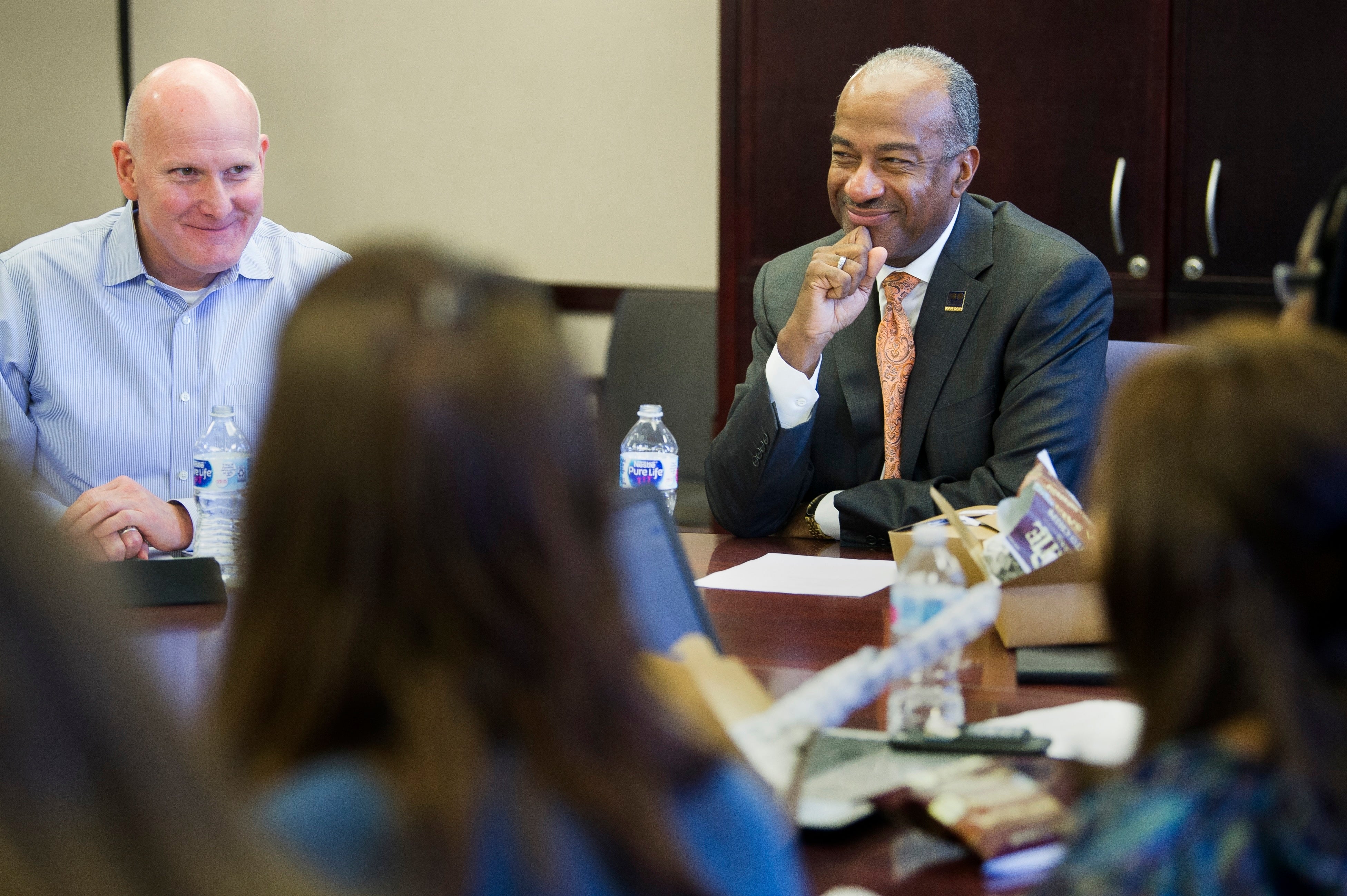
After leaving the state commission, Engelbach joined the University of California systemwide office in Sacramento, working in government relations. He later returned to Davis to lead federal government relations for the campus. It was a homecoming of sorts: the place where he had begun his education was now the institution he was helping represent.
Then Chancellor Linda P.B. Katehi asked Engelbach to consider applying for the chief of staff position. He got the job and began in January 2011.
He quickly learned that the position required more than expertise. It required judgment.
One of the most consequential moments came early in his tenure, during a 2011 campus protest in which students demonstrated as part of the Occupy movement and were met by campus police who used pepper spray on protesters. He remembers seeing officers lined up in riot gear before they entered the Quad.
“My stomach kind of churned,” he said. “Because this is my campus and I'd never seen anything like this. This isn't what we do here.”
At the time, Engelbach was still learning the boundaries of his new role. He questioned how much authority he had to speak up. In retrospect, the experience fundamentally changed his approach to leadership.
“I should have listened to my instincts and said: ‘Something's wrong. We should reconsider,’” he said.
The lesson stayed with him.
“If something feels wrong, you need to give voice to it and you need to express it,” Engelbach said. “Trust your gut and speak up.”
The incident also led to significant reforms in how UC Davis approached freedom of expression, protests and policing. He points to those changes as one of the lasting contributions of his career.
Today, he said, campus police are more integrated with the community, while student affairs professionals play a larger role in supporting students during demonstrations and other expressions of protest.
Another of his contributions has been UC Davis’ growing presence in Sacramento.
For years, Engelbach heard from Sacramento leaders who wanted UC Davis to become more visibly engaged with the region. The creation of Aggie Square, he said, represented an important step toward demonstrating that UC Davis is not simply near Sacramento — it is part of Sacramento.
Engelbach also helped change the experience of commencement for UC Davis undergraduates. As the number of graduates grew, holding ceremonies on campus required multiple events and was constrained by available space.
He advocated for moving undergraduate commencement ceremonies to Golden 1 Center in Sacramento.
There was plenty of initial resistance.
“People are afraid of change,” he said.
But the response from students and families has since been overwhelmingly positive, Engelbach said. For him, the change was ultimately about giving graduates and their families a more memorable and dignified experience.
During his tenure, he also helped establish the campus Ombuds Office, creating a confidential and impartial resource for students, faculty and staff seeking help navigating problems or conflicts.
And he helped consolidate UC Davis’ government relations operations, which had previously been divided between the Davis and Sacramento campuses. Bringing those functions together meant the university could advocate with one voice.
Engelbach considers these among the most important pieces of his legacy.
A career without a blueprint
Perhaps the most revealing thing about Engelbach’s career is that he never intended for it to unfold this way.
After graduating from UC Davis in 1988, he continued his education at the university’s Graduate School of Management. He was part of the first class to receive an MBA from the program.
Even then, he said, he didn't have a clear career plan.
Rather than viewing that uncertainty as a weakness, he now sees it as an advantage.
“The opportunities are big and small that are in front of us every day,” he said. “Just be open to learning new things.”
That openness has remained central to his philosophy.
Engelbach said one of the things he has loved most about working at UC Davis is that every day brings something new. He has worked with students, faculty, staff, administrators, elected officials and community members, giving him a view of the university that few people have.
“I don't have a day here that I'm ever bored,” he said. “I wake up and I think, ‘Oh my gosh, I'm going to be inspired by someone today.’”
He is particularly impressed by UC Davis students and their willingness to pursue ambitious goals not only for themselves, but for their peers and their communities.
“I talk to our student leaders on campus and I'm just in awe of what they're attempting to accomplish,” he said.
That sense of possibility is something Engelbach hopes to pass along.
Throughout his career, he has benefited from mentors who took him under their wings, including J. B. Hefferlin, whom he worked closely with at CPEC. Early in his career, Hefferlin taught him the importance of writing, communication, organization and persuasive argument.
He says mentorship has remained a constant throughout his career, even when it isn't formal or intentional.
“Even today, I feel like I'm surrounded by mentors, even though they don't realize they're mentoring me,” Engelbach said. “They are, every day.”
He hopes to return that investment by mentoring others, saying he feels he should do more to “repay all of that great mentorship” he has received over the years.
Leaving with gratitude
Retirement, for Engelbach, does not mean disengagement.
He plans to remain professionally involved, particularly through volunteer opportunities in higher education. He also hopes to travel more, spend time in the Philippines with his partner and his partner's family, and finally tackle some of the personal projects that work always seemed to postpone.
“I don't think I'm just going to stop being engaged intellectually,” he said. “I enjoy that too much.”
After spending so much of his life at UC Davis, the hardest part of retirement may be leaving the people behind.
“We have incredible people here,” Engelbach said. “Every day, I'm energized by someone I talk to.”
He describes his role as helping people navigate the university's policies, bureaucracy and other obstacles so they can accomplish what they set out to do.
Engelbach’s approach has evolved over the years. When he was younger, he found the slow pace of institutional change frustrating. With experience came a deeper appreciation for patience, listening and coalition-building.
“You're not going to move a whole organization all on your own,” Engelbach said.
The same philosophy applies to leadership.
He has learned that being a leader does not mean being liked by everyone. That can require a thick skin, particularly in a high-profile role. His advice is simple: stay professional, remain collaborative and take the high road.
As Engelbach prepares to leave UC Davis, he hopes people remember him not for a particular title or initiative, but for how he treated them.
“I hope they'll remember I was an OK listener, that I was empathetic, a problem solver, a partner.”
Media Resources
Anila Lijo is a writer and editor for the Office of Strategic Communications, and can be reached by email.