

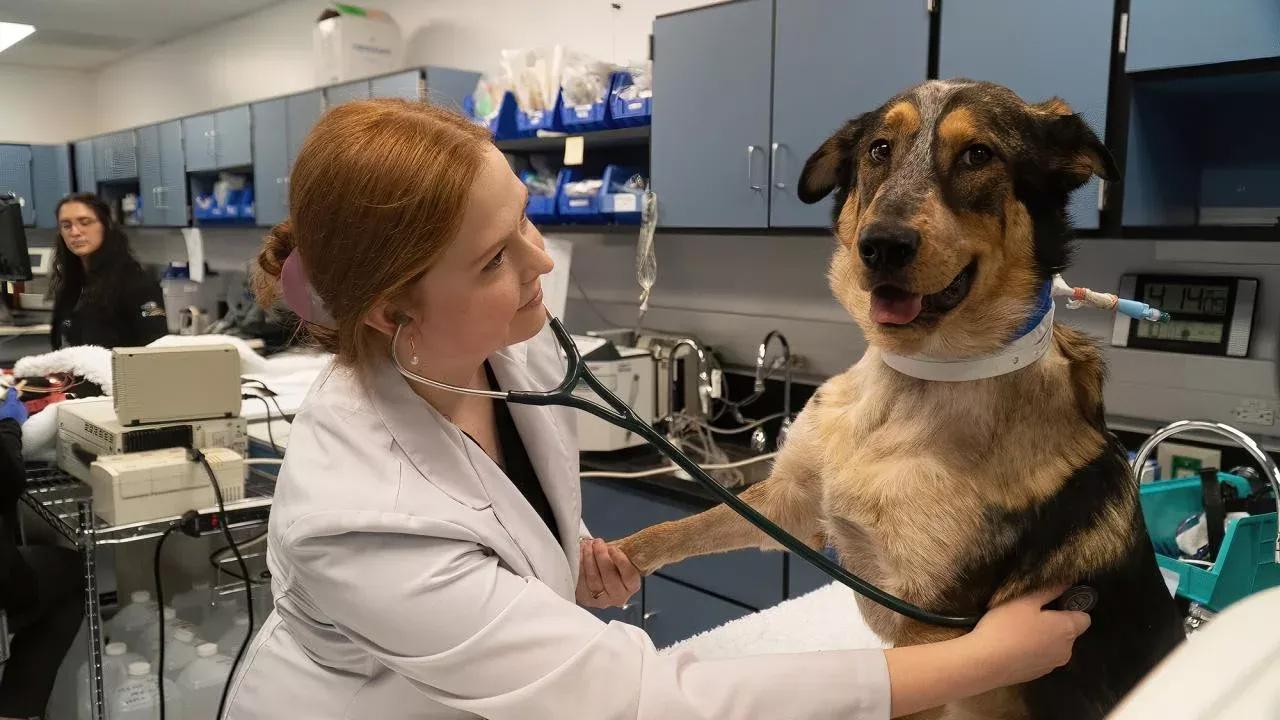
At the UC Davis School of Veterinary Medicine, compassion meets innovation. When Kailana, a joyful Golden Retriever puppy, faced the risk of paralysis, our neurosurgeons, supported by the Compassionate Care Fund, executed a delicate, seven-hour spinal surgery to secure her long-term mobility, showing how our boundary-pushing expertise transforms care.
Stories like this happen every day at the nation’s No. 1 veterinary school. We’re training the next generation of veterinarians and developing research offering hope for animal and human health.
Today, we’re working to expand our capacity to serve our community, and your support will help us achieve more.
A need for more veterinarians
When the School of Veterinary Medicine welcomed 42 students in 1948, it met California’s urgent need for veterinarians. By 1978, our school was an internationally recognized innovator in clinical education. We developed the clinical training model for fourth-year DVM students in the Veterinary Medical Teaching Hospital, establishing the national standard for teaching veterinarians.

The need for quality veterinary treatment has not diminished. A 2024 report reveals that a shortage of primary care veterinarians in the United States is reducing access to appointments, delaying treatment and increasing costly emergency visits.
This shortage extends to California, where it affects treatment availability across the state, including two-thirds of shelters that struggle to meet basic medical needs.
At UC Davis, we play a vital role in meeting that need. We’re the premier hospital in the region, serving 50,000 animal patients a year with specialized, innovative care, and we remain a vital training ground for veterinarians serving our state.
New types of treatment
Our Veterinary Center for Clinical Trials offers renewed hope to clients whose animals aren’t responding to existing treatments. With more than 30 clinical trials underway at any given time, we provide options for pets that might otherwise have none while also advancing veterinary care. One of those clinical trials led to a breakthrough dialysis and blood purification treatment, saving the lives of cats and dogs at UC Davis facilities here in Davis and in San Diego.
Whether it is developing novel therapies to treat cancer or protecting horses' eyesight, these clinical trials — often supported by federal funding — make advanced treatments available while expanding our knowledge of animal health.
The teaching hospital also uses advanced diagnostic imaging to protect animal health across companion, livestock, equine and wildlife species. Our new All Species Imaging Center is one of the best facilities in the world for this work. Technicians can capture highly detailed images, even of standing horses and cattle, allowing veterinarians to detect disease or injury earlier and guide more precise treatments.
And our work offers incredible potential for human health as well. Along with our partners at UC San Francisco, researchers at UC Davis recently completed a clinical trial of a new cancer drug for a carcinoma previously considered untreatable in cats. Not only did 35% of the treated cats have their disease controlled, but the study also identified potential models for treating human health.
This translational medicine research — sharing insights between human and animal medicine — extends to other diseases. Another team at UC Davis developed a treatment for cats with severe disease, and we’re continuing to research potential applications for humans experiencing long COVID.
A helping hand
Because service is at the heart of our mission at UC Davis, we extend treatment to our entire community. Since 1992, the Mercer Veterinary Clinic has provided compassionate outreach for the pets of individuals experiencing homelessness, work that extends to the Davis Pet Advocacy and Wellness program right here.
Since 2001, our Koret Shelter Medicine Program has played a vital role in assisting animals in shelters. Its experts are developing studies to reduce illness and enhance care nationwide, and training veterinary residents to specialize in this critical area of need. The program also administers the California for All Animals grant program, providing health support and training to area shelters while our students, from residents to undergraduate interns, gain critical experience.
The need for support
Our School of Veterinary Medicine and its teaching hospital are making a difference here in Davis and beyond. With your support, we can expand facilities and resources to deliver more care and discover new treatments that benefit both animals and human health.
Our Veterinary Medical Complex project kicked off its next major phase in September. It will increase our patient capacity, unlock research serving both animals and humans and expand our Doctor of Veterinary Medicine class sizes from 600 to 800 students.
The Capital Project is progressing with $110.5 million raised from philanthropic gifts, but to fully realize it, we need strong public and state support. We ask leaders in our community to champion the funding necessary to complete this effort and expand our impact in Davis and beyond.
Today, Kailana is romping in the backyard with her family and other dogs — a testament to what’s possible today and a glimpse of the countless hopeful stories we continue to create at the School of Veterinary Medicine.
Chancellor Gary S. May’s monthly column is published in The Davis Enterprise and Dateline UC Davis.