

Fifty years ago, punk rock was born — at least as close as anyone can say for when greater awareness of the burgeoning movement began — and Kevin Dettmar ’81 was a freshman at UC Davis.
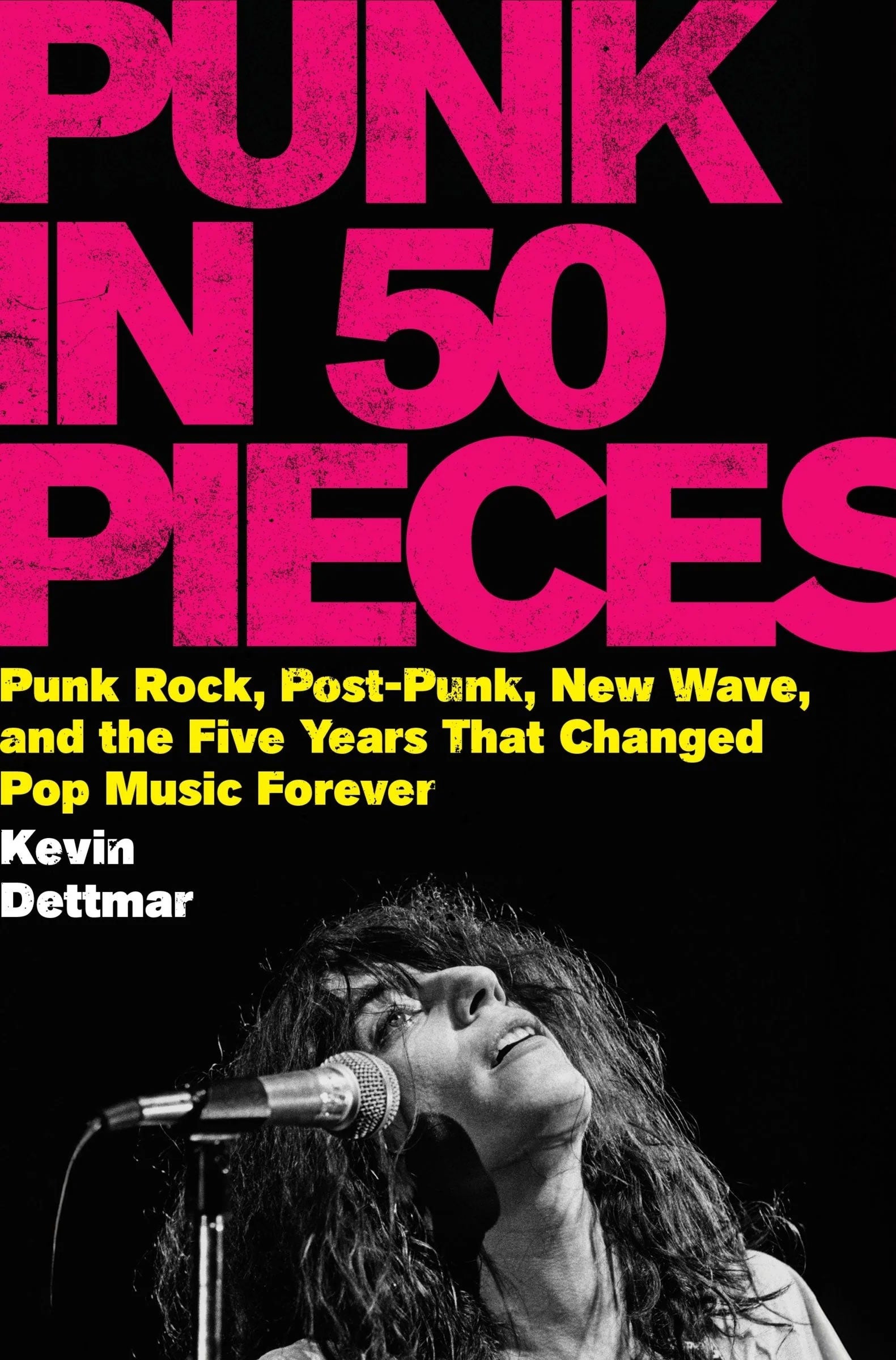
His new book, Punk in 50 Pieces (Harper Collins, 2026), celebrates the milestone anniversary with an examination of 50 songs of the genre, post-punk and new wave released in the subsequent five years. It is on sale Sept. 8.
The book’s introduction sets the stage for Dettmar’s initiation through concerts at the UC Davis Coffee House. During that time, Elvis Costello, Devo, Talking Heads, The Police, Gang of Four and more all appeared on campus.
The music spoke to Dettmar.
“I was one of those kids who was a bit of a culture vulture,” he said. “A lot of punk for me was a little too lowbrow or too simplistic. There wasn't anything to really sink my teeth into.
“Whereas Gang of Four is maybe the textbook example [of something deeper], because they're thinking about feminist art theory and Marxist theory. Their songs are sung from the point of view of these mystified subjects of consumer culture who don't quite understand the forces that are operating on them.”
Dettmar, a double major in English and psychology, acknowledged these five years of music fall during Dettmar’s time at UC Davis.
“I’m honest about that up front, that the greatest five years of pop music history were when I was in college,” said Dettmar who is a professor of English at Pomona College. “Lots of people would say that that period is especially robust. I’m not just centering it around my own experience.”
Here, Dettmar talks about the new book and what’s next for him.
How did the idea for this book come about?
I'm driving out to see my agent, and I know she’s going to want me to have an idea for a book. I haven’t even remotely been thinking about a book, but I had been writing a lot for the Atlantic and the New Yorker— freelance online pieces — about 1,200 to 2,000 words. And I’ve gotten really comfortable with that. So, even though my work responsibilities are kind of heavy, I know I could write 50 of these. I knew too that the 50th anniversary — [when] the Sex Pistols first all came out in November ’76 — is coming up, and publishers like anniversaries. What about 50 pieces, about 50 songs for the 50th anniversary? So yeah, essays, like little mini-essays, I guess, kind of hot takes on one or two salient things about each of the songs.
How did you put together the final list of 50 songs?
You can imagine the problem isn’t trying to come up with 50; it’s to try to cut it down. So there are a bunch of rules. One is that no band gets to have two. Because if you did, the Clash and Sex Pistols and Talking Heads, there are lots of bands that would have a bunch. Because John Lydon leaves the Sex Pistols and forms a Public Image LTD, there are two pieces that are really about John Lydon. The songs had to have been issued as a single, not just a track on an album, because those are the songs that the label is betting on, they’re getting some attention. They were cheap, like in the U.S. they were a buck, so they’re more broadly available. And they tended to get played on the radio. And then the dates — [released between] fall of ’76 to summer of ’81.
Are you expecting some feedback on this list?
Even my editor — we don't fight, we get along great — but we had some friction over some of it. Like the piece on The Police is “Roxanne,” and it’s a problematic song and I find it completely irresistible. If it comes on the radio I’m turning it up and I’ll try to do the harmonies. I get why it’s attractive, but the narrative is super messed up. And so, I think one thing my editor wasn't initially expecting was that these aren’t all adulatory necessarily. But a book about this period has to have The Police in it. And I don’t like The Police.
Some of [the pieces] were a little bit cranky, and I imagine I’ll get some grief for that. And that’s okay. I mean, I think one of the problems with music writing, generally, or music criticism, is that we too often don’t make the move from fan to critic. And you need to be able to be both a fan and a critic. Like Neil Young is the greatest artist of the 20th century, and I will go to the mat and fight for him every time. He also wrote some terrible songs and some terrible albums, and we need to be able to say both of those things at one time.
What is your next project?
My next book is going to be about cover songs, I think. A book that looks at why we make them and what they do for an artist. One of the distinctions I’m trying to make is between a version and a cover. And the distinction for me is that a cover is a recording that’s referencing a previous recording. So when Jimi Hendrix plays the “Star Spangled Banner” at Woodstock, it's not a cover because there’s no recorded original like reference version of the “Star-Spangled Banner.” It’s a version, and it’s really powerful. But when Prince plays [the last on guitar solo in] “While My Guitar Gently Weeps” at the Rock and Roll Hall of Fame induction for George Harrison, to me, that’s the most staggering cover I’ve ever heard of a song.